
from Wall Street Silver
California Fast Food Prices Soar as Minimum Wage Hike Takes Toll
Minimum wage increase forcing restaurants to pass operating costs onto consumer.
by Infowars.com
Info Wars
 Consumers of fast food in California are paying more for meals after the state’s new minimum wage law went into effect, local media reports.
According to Fox 11 Los Angeles, the minimum wage increase for fast-food workers touted by Democrat Gov. Gavin Newsom that hiked hourly pay to $20 is negatively affecting consumers, who have to shell out more at restaurants.
[…] “Fast food workers got a raise and customers are apparently paying the price — literally,” a Fox 11 anchor described.
“Since the minimum wage went up to $20 an hour, many restaurants have raised their prices, and one research company looked at 25 different chains and found that many of their items went up in cost.”
Some fast-food joints that increased prices include Wendy’s (8%), Chipotle (7.5%), and Starbucks (7%), according to the Kalinowski Equity Research firm.
West Red Lake Gold: Primed for Near-Term Production with Top-Tier Team & Infrastructure
from Kerry Lutz's Financial Survival Network
We met with West Red Lake Gold’s (🇺🇸WRLGF — 🇨🇦WRLG new sponsor), CEO and President, Shane Williams. He is a true mine builder, having brought 5 prior mines online. He highlighted his action-oriented approach and the strategic decision to join WRLG, attracted by its incredible potential.
Shane revealed the latest drill results from the Madsen mine’s South Austin Zone, intersecting 68.36 g/t Au over 1.1m and 13.83 g/t Au over 3.95m. He has assembled one of the most solid teams in his experience, explaining how these moves have given WRLG the ability to start producing in Q4 ‘25. Discussing the primary focus on the Madsen mine, once valued at $1 billion, Shane provided insights into the timetable for restarting production and the steps he’s taken to mitigate inflation impacts on project costs. He’s still surprised by the company’s good fortune in acquiring the existing mill and infrastructure (for just pennies on the dollar) noting that replacement costs are north of $700mm. Following the previous management’s inability to acquire profitability, he’s busy capitalizing upon this once in a lifetime opportunity.
He commented on the continued excellent drill results, the strategic challenges ahead, and the catalysts for success. With current gold prices holding strong, Shane is excited by the positive impact on WRLG’s economics as well as the broader industry.
Highlighting recent successful funding efforts, Shane contrasted WRLG’s position with peers who have struggled to survive, underscoring key strategies for maintaining operational momentum. For these reasons we have taken a position in WRLG.
Sign up (on the right side) for the free weekly newsletter.
How Inflation Impacts Cash, Stock Markets, Investments and a Possible Housing Market Crash with John Grace
from Kerry Lutz's Financial Survival Network
Kerry and John Grace discussed the changing role of utilities in the context of electric vehicles and artificial intelligence trends. The speakers emphasized the need for increased stations and the limitations of solar and wind power. They also explored the potential of battery power to stabilize the grid and address the challenges faced by millennial first-time homebuyers. The conversation provided insights into the changing landscape of utilities and real estate, shedding light on the implications for both industries in the current market. John and Kerry also discussed the significance of consumer age in shaping buying and selling behavior, drawing attention to the historical trends in home purchasing and the age at which individuals typically make significant property investments. The speakers highlighted the impact of life expectancy on housing market dynamics, emphasizing the need for forward-looking asset management strategies. The discussion also delved into the challenges of selling a property that has doubled in price, with considerations for relocation and the financial implications. Overall, the conversation emphasized the importance of being prepared for market fluctuations and making strategic decisions to safeguard assets.
Click Here to Listen to the Audio
Sign up (on the right side) for the free weekly newsletter.
Living On Uneasy Street
by Charles Hugh Smith
Of Two Minds
 It’s nice to anticipate sunny weather, but it’s a good idea to carry an umbrella just in case the forecasts prove overly optimistic.
Yes, the market will rally if World War III didn’t start last night. The market will also rally if World War III does start, because the Federal Reserve will surely lower interest rates.
We chuckle uneasily at gallows humor here on Uneasy Street because we’re still required to maintain an upbeat veneer of endlessly cheerful optimism even as we sense that the forces currently in play are beyond the control of individuals or groups, no matter how powerful they may be, and that these forces will follow a course to an end no one can predict with any degree of upbeat confidence.
Back when we lived on Easy Street, things were getting better for everyone in varying degrees and the ladder of social mobility was available to all: anyone could improve their prospects by putting in the effort.
What Happened to Bitcoin?
by Jeffrey Tucker
Daily Reckoning
 Those who involved themselves in Bitcoin markets after 2017 encountered a different operation and ideal than those who came before.
Today, no one much cares about what came before, speaking of 2010–2016. They are only watching the upward price momentum and are thrilled for the increase in the asset valuation of their portfolio.
Gone is the talk of separating money and state, of a market-based means of exchange, of genuine revolution that would extend from money to the whole of politics the world over.
And gone is the talk of changing the operation of money as a means of changing the prospects for freedom itself. The enthusiasts around Bitcoin have different goals in mind.
Inspired Idiot of the Week: California Edition
by James Hickman
Schiff Sovereign
 Veronica Perez was skeptical when city workers found her under the Los Angeles highway overpass she called home.
They presented her with an opportunity to move into a private room—a converted hotel room, part of a state initiative where some units were renovated at costs approaching $400,000 each.
Before long, Veronica found herself receiving three meals a day delivered straight to her door and participating in weekly painting classes. Additionally, she began receiving free medical care.
This was one of several California state programs meant to address homelessness. Others spent up to $4,000 per person a month putting the homeless up in motels and hotels, including some name-brand hotels like the Radisson.
The Latest Updates From Martin Armstrong for 2024.04.21
by Martin Armstrong
Armstrong Economics
US’s Political Prisoner – What They Do When They Have no Case
Ukraine – Approaching the Last Ukrainian Standing
Former Democrat Comes Out Against the Democratic Agenda
Russia Tests an Undetectable Supersonic ICBM
There Should Be a Civil Rights Case Against this Judge & Bragg to Get into Federal Court
OMG We Will All Die by 2027? Party Time!
Why the U.S. Debt is Unsustainable and is Destroying the Middle Class
by Daniel Lacalle
Mises.org
 In a recent tweet, a talented financial analyst and investor stated: “The “debt is unsustainable” narrative has been around for 40 years plus. What’s astonishing to me is how the people who push this narrative never ask themselves, “Why has it been sustainable for so long?”.
There is a widespread idea that the fiscal imbalances of a world reserve currency issuer would end in an Argentina-style bankruptcy. However, the manifestation of unsustainability did not even appear as drastic in Argentina itself. Hey, Argentina continues to exist, doesn’t it?
Excessive public debt is unsustainable when it becomes a burden on productive growth and leads the economy to constantly rising taxes, weaker productivity growth, and weaker real wage growth.
“Weekend at Bernie’s Economy”: Joe Biden, Seeking Another Term, Wheels Out the Corpse of the U.S. Economy
by Michael Snyder
The Economic Collapse Blog
 When I was a kid, “Weekend at Bernie’s” was one of my all-time favorite movies. In that film, two guys worked really hard to convince everyone that their boss was still alive so that they wouldn’t get into trouble. I remember laughing throughout that entire movie. Today, the Biden administration is working really hard to convince all of us that the U.S. economy is still alive, and that isn’t funny at all. A horrific cost of living crisis is absolutely crushing millions of U.S. households, large companies are conducting mass layoffs all over the nation, and the real estate industry is in a gigantic mess. But Joe Biden and his minions would have us believe that everything is just fine.
What we are witnessing is so similar to a very shocking incident that recently happened in Brazil.
A very disturbed woman, seeking a loan, actually wheeled a corpse into a local bank…
Migrants in Germany Went on Record-Breaking 2023 Crime Spree
by Ben Bartee
The Daily Bell
 Originally published via Armageddon Prose:
On this 4/20, the birthday of the world’s most infamous Adolf, let’s note that Germany’s trajectory — from the world’s most notorious ethnonationalist state a mere 80 years ago to its current form, a multicultural cesspool of anarcho-tyranny — has to break some kind of historical record for irony.
Via Remix:
Why the Great Labor Arbitrage is Coming to an End…
by David Stockman
LewRockwell.com
 When it comes to Keynesian central banking, it might well be said that if you paint by the numbers you are stuck with the brush. That is to say, the Fed has turned its 2.00% target into an economic holy grail and therefore does not dare risk a rebound of the 40-year high inflationary pressures that remain directly in the rearview mirror.
Yes, the inflation gauges have cooled considerably since the 9% CPI (Consumer Price Index) peak of June 2022, but the Fed is not yet remotely out of the woods. In fact, when the inflation tide is viewed through the more stable and reliable lens of the 16% trimmed mean CPI, which peaked at a somewhat lower 7.2% level in 2022, the year-over-year (Y/Y) gain at 3.7% in January was still barely halfway back to the sacrosanct 2.00% goal.
Indeed, the annualized three-month rate of change in the trimmed mean CPI has rebounded to 4.0% already, while the annualized rate for January came in at a red hot 5.7%.
New Title IX Rules Erase Campus Due Process Protections
The new rules allow students to be found guilty of assaulting a classmate without ever seeing the full evidence against them.
by Emma Camp
Reason.com
 On Friday, the Biden administration unveiled final Title IX regulations, nearly two years after the administration proposed dramatic changes to how colleges handle sexual assault allegations. The new rules largely mirror proposed regulations released last year and will effectively reversing Trump-era due process reforms.
According to the final regulations, accused students will lose their right to a guaranteed live hearing with the opportunity to have a representative cross-examine their accuser. This is accompanied by a return to the “single-investigator model,” which allows a single administrator to investigate and decide the outcome of a case.
Further, under the new rules, most schools will be required to use the “preponderance of the evidence” standard, which directs administrators to find a student responsible if just 51 percent of the evidence points to their guilt.
Nvidia, Supermicro Make Huge Mess of AI-Semiconductor Mania, Netflix Plunges, Big Tech Follows
by Wolf Richter
Wolf Street
 Nasdaq fell 2.05%, back to where it had been in September 2021. We have some new WTF Charts of the Year.
The Nasdaq Composite fell 2.05% today to 15,282, back to where it had first been in September 2021. Since the all-time high on March 21 of 16,538, it has dropped by 7.6%.
Seems, the AI and semiconductor hype-and-hoopla show got interrupted somehow, or maybe it got too silly and people just started walking out of it. Some of the biggest names in that show plunged today – and we’ll get to a few in a moment.
Chicago is the DNC’s Kind of Town?
by Clarice Feldman
American Thinker
 I’m old enough to remember the 1968 DNC convention in Chicago, and smart enough to see that Chicago Mayor Brandon Johnson is no Richard J. Daley. So, as food prices rise with no end in sight, I advise you to stock up on popcorn before the August 19 convention in Chicago this year. As for the Democrats, I cannot imagine a scenario where there is anything but downsides for picking this site, this year.
In case you forgot, the 1968 convention began with ominous foreboding. True, the mayor had done everything he could to prettify the city, including screening the stockyards with redwood fences, but he knew the anti-Vietnam protestors would target the convention and mobilized the National Guard with orders to shoot if necessary.
What followed was worse than even the direst pessimist could have envisioned. Written in 2008, this author described the scene and aftermath:
Democrats Chant ‘Ukraine’, Wave Ukraine Flags in the House as They Pass $60 Billion Aid Bill
by Steve Watson
Modernity News
 Republicans could barely believe what they were witnessing Saturday as Democrats passed a $61 billion aid package for Ukraine, broke out into chants of ‘UKRAINE, UKRAINE,’ and waved Ukrainian flags on the floor of the House of Representatives.
The bill, titled the Ukraine Security Supplemental Appropriations Act, passed by a vote of 311-112.
In addition to the Ukraine funding, there was more foreign aid outlined in the legislation for Israel and other US allies, amounting to a total of $95 billion.
As soon as the result was in, Democrats began to wave the flags and chant.
UN Plans Tyrannical Future for You – Alex Newman
by Greg Hunter
USA Watchdog
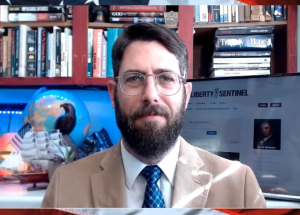
Award-winning journalist Alex Newman, author of the popular book “Deep State” and the new best-selling book called “Indoctrinating Our Children to Death,” says the UN’s quest for total tyrannical control of your life is coming sooner than you could imagine. Newman explains, “The bigger story here that people are not paying attention to is the UN is coming together in September . . . and they are having ‘The Summit of the Future.’ They are telling us they are going to bring out radical drastic reforms in the structure of the UN . . . and the power of the UN. Think of it as the biggest power grab ever at the global level. The Secretary General of the UN (António Guterres) has put out briefs where he is calling for the UN to be the one world global dictatorship with him at the helm. In emergencies, the UN would have all power in emergencies and have all power to oversee emergency response. . . . They say the crisis could be a climate crisis, an economic crisis, environmental crisis, pandemic crisis, black swan crisis or maybe something from outer space. So, basically, anything could be a crisis, and when the Secretary General declares a crisis, all power and authority would go to the UN. This is like a blank check on the wealth and liberty on every person on the planet, and this is coming soon. It is eminent. This is coming in September at the UN, and it is a power grab of historic proportions. They know their time is short, and they are going for the big enchilada here. This is really a summit for a tyrannical future. . . . They want control of every aspect of your life.”
